
“The Bose-Einstein Condensate” is a groundbreaking achievement in the field of physics, for which Eric A. Cornell, Carl E. Wieman, and Wolfgang Ketterle were awarded the Nobel Prize in Physics in 2001. It marks a significant milestone in our understanding of quantum mechanics and the behavior of matter at extremely low temperatures. Some of the optical components used in these experiments were developed by Meadowlark Optics.
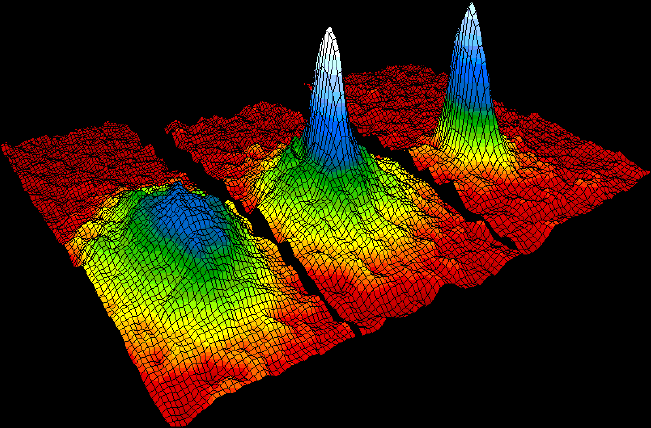 Time of flight images of temperature variance in Bose-Einstein experiments[/caption]
Here are some key details about the Bose-Einstein Condensate (BEC):
1. Discovery: Eric A. Cornell and Carl E. Wieman, both physicists, along with their colleague Wolfgang Ketterle, achieved the first creation of a Bose-Einstein Condensate in 1995. They cooled a dilute gas of bosonic atoms to temperatures very close to absolute zero, where the individual atoms lose their distinct identities and behave collectively as a single quantum entity.
2. Theory: The Bose-Einstein Condensate is a state of matter predicted by Albert Einstein and Indian physicist Satyendra Nath Bose in the 1920s. It arises when a dilute gas of bosons (particles with integer spin, like photons, helium-4 nuclei, and certain atoms) is cooled to temperatures close to absolute zero. At this point, the de Broglie wavelength of the atoms becomes comparable to the average inter-particle distance, leading to quantum effects dominating the behavior of the system.
3. Behavior: In a BEC, all the atoms occupy the lowest quantum state, known as the ground state. This results in a macroscopic wave function that describes the collective behavior of the atoms. BECs exhibit unique properties, such as superfluidity and coherence, making them valuable for studying fundamental physics and potentially for applications in precision measurements and quantum computing.
4. Experimental Setup: Cornell, Wieman, and Ketterle used laser cooling and evaporative cooling techniques to cool a gas of rubidium-87 atoms to temperatures just a few billionths of a degree above absolute zero. They trapped the atoms using magnetic fields and further cooled them to form the BEC.
5. Significance: The creation of the Bose-Einstein Condensate opened up new avenues of research in physics, providing insights into quantum phenomena at a macroscopic scale. It has led to advances in fields such as atomic physics, condensed matter physics, and quantum optics. Additionally, the techniques developed for creating and manipulating BECs have found applications in areas such as precision measurements and quantum information science.
Overall, the discovery of the Bose-Einstein Condensate represents a remarkable achievement in experimental physics, demonstrating the power of combining theoretical insights with innovative experimental techniques to explore the fundamental nature of matter at the quantum level.
We use cookies to improve your experience on our site. By using our site, you consent to cookies.
Manage your cookie preferences below:
Essential cookies enable basic functions and are necessary for the proper function of the website.
These cookies are needed for adding comments on this website.
Google Tag Manager simplifies the management of marketing tags on your website without code changes.
Statistics cookies collect information anonymously. This information helps us understand how visitors use our website.
Google Analytics is a powerful tool that tracks and analyzes website traffic for informed marketing decisions.
Service URL: policies.google.com (opens in a new window)
SourceBuster is used by WooCommerce for order attribution based on user source.
Marketing cookies are used to follow visitors to and from 3rd party websites. The intention is to show ads that are relevant and engaging to the individual user.
Pinterest Tag is a web analytics service that tracks and reports website traffic.
Service URL: policy.pinterest.com (opens in a new window)